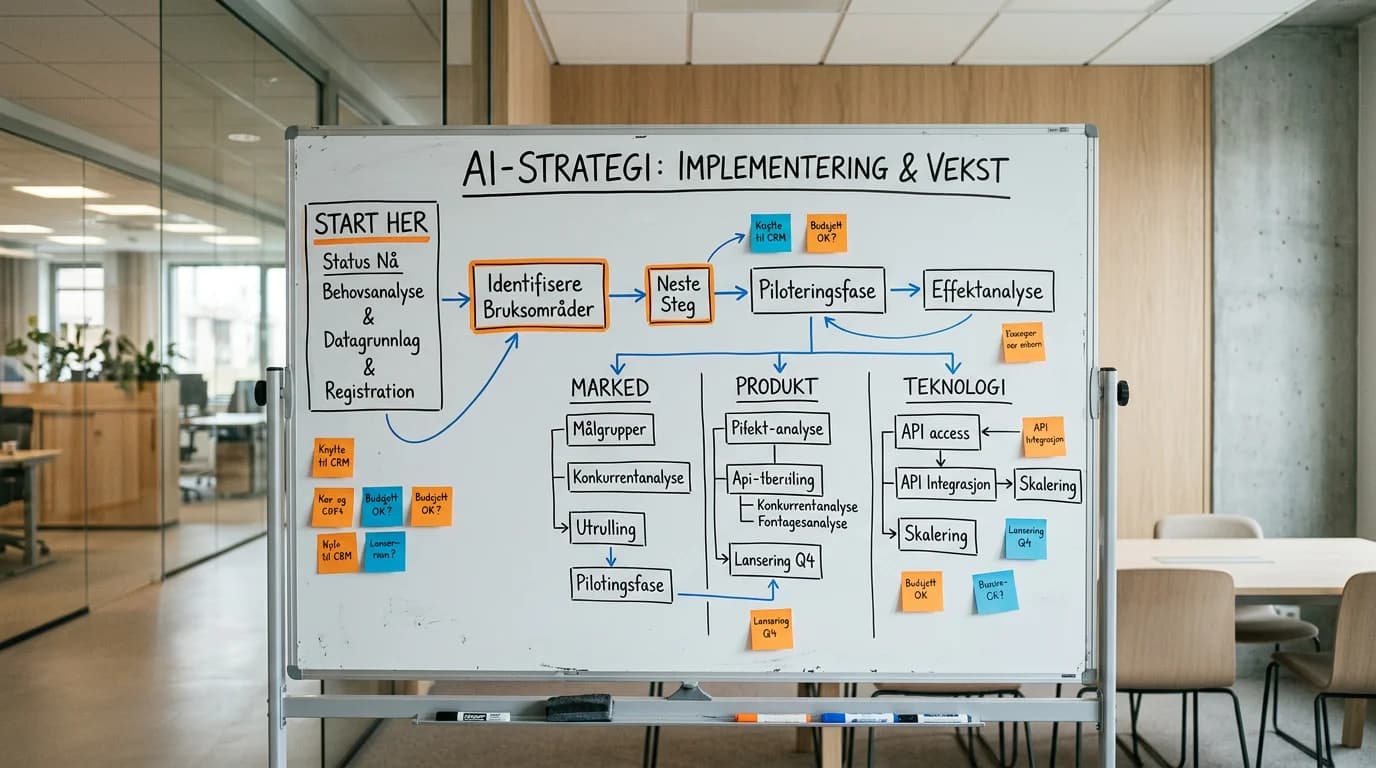

In brief: Nearly every company is increasing AI investments in 2026, but few are seeing concrete results. Fresh data from Deloitte and Gartner reveals a growing gap between ambition and impact. Here's what the numbers tell us, and what separates the businesses that succeed.
Everyone is investing, few are delivering
The figures from Deloitte's "State of AI in the Enterprise 2026" paint a paradox. 86% of companies are increasing their AI budget this year. At the same time, the report shows that only 20% have actually achieved revenue impact from their AI initiatives, despite 74% having this as a stated goal.
The gap between investment and results is not new, but it's growing. In 2025, 12% reported that AI had a transformative effect on their business. In 2026, this has doubled to 25%. Progress is real, but it's concentrated among a minority.
For Norwegian businesses, the picture is similar: 55% are using AI in 2026, up from 24% in 2023. The growth is impressive. The question is whether this usage delivers measurable value.
Agentic AI: Big potential, low maturity
AI agents are 2026's dominant theme. Gartner estimates that 40% of enterprise applications will integrate task-specific AI agents by year's end, up from under 5% in 2025. Deloitte reports that 85% of companies plan to customise agents for their own needs.
But the reality behind the headlines is more modest. According to recent industry data, only 11% of companies are actually in production with agentic AI systems. 38% are piloting solutions, 30% are exploring options, and the rest are waiting.
Perhaps the most striking finding is this: Gartner predicts that over 40% of agentic AI projects will be cancelled by the end of 2027 due to escalating costs, unclear business value, or inadequate risk management.
In other words: the problem is not a lack of initiative. It's the quality of the initiatives.
What characterises the 20% that succeed?
The Deloitte report identifies clear patterns among companies that actually see results:
- Clear success criteria from the start. They set measurable goals before choosing tools. Not "we should use AI", but "we should reduce customer enquiry handling time by 30% by Q3".
- Business problem first, technology second. Companies that start with a defined problem succeed far more often than those that start with the technology and search for use cases.
- Cross-functional ownership. Where IT, business, and leadership collaborate from day one, the likelihood of scaling is significantly higher. AI projects "owned" by IT alone most often stall in the pilot phase.
- Governance and frameworks. Only 21% have a mature framework for agent governance. Those that do scale faster and with fewer problems.
For Norwegian businesses, this confirms a familiar pattern: those reporting the highest satisfaction with AI have established frameworks for measuring success, use AI as a central element in their strategy, and focus on strengthening competitive advantages.
Three common traps Norwegian businesses should avoid
1. Tool shopping without direction
It's tempting to start by testing the latest AI tool. But Deloitte's data shows that companies choosing tools before defining the problem rarely get past the experiment phase. Start by mapping where the biggest bottlenecks are, and work from there.
2. Pilots without a scaling plan
42% of respondents say that optimising AI workflows is their top priority in 2026. But many pilots are designed as one-off experiments without a plan for integration into daily operations. A pilot without a scaling plan is an expensive demonstration.
3. Underestimating data quality and talent
Deloitte's figures show a concerning trend: technical infrastructure readiness stands at 43%, data management at 40%, and talent readiness at just 20%. These numbers have actually dropped compared to last year's report. Companies are realising that AI implementation demands more than they expected.
From individual use to workflow orchestration
One of the most important shifts in 2026 is the transition from AI as an individual productivity tool to AI as workflow orchestration.
In practice, this means AI is no longer just helping individuals write emails faster. The most mature organisations are using AI to coordinate entire work processes: connecting data across departments, automating approval flows, and moving projects from idea to completion.
34% of companies report that they are already using AI to deeply transform their business through new products and services, changed core processes, or fundamentally new business models. The rest are optimising existing processes, which also delivers value, but rarely provides competitive advantage.
What should Norwegian businesses do now?
Based on data from Deloitte, Gartner, and Norwegian industry surveys, four concrete steps give the best foundation for success:
-
Choose one business problem. Don't start with "we should use AI". Start with "we spend 40 hours per week on manual invoice processing" or "customer service has a 3-day response time". A specific problem yields a measurable result.
-
Set success criteria before choosing tools. Define what success looks like in numbers: percentage time saved, money saved, cases handled. Without this, you won't know whether the AI project succeeded.
-
Build cross-functional ownership. Involve leadership, domain experts, and IT from the start. AI projects that live only in the IT department die in the pilot phase.
-
Plan for scaling from day one. Design the pilot as a first step, not an isolated experiment. Consider data quality, integrations, and training already in the pilot phase.
Need help identifying the right use case and creating a concrete plan? An AI Audit gives you a prioritised roadmap based on your company's actual processes, data and goals.
Summary
2026 marks a turning point for enterprise AI. Investments are rising, ambitions are high, and the technology is maturing. But the data clearly shows that it's not the tools that determine success. It's the ability to connect AI to concrete business problems, measure results, and scale what works.
The businesses that succeed in 2026 are those that treat AI as a strategic investment with clear ownership, not as a technology experiment in the IT department.