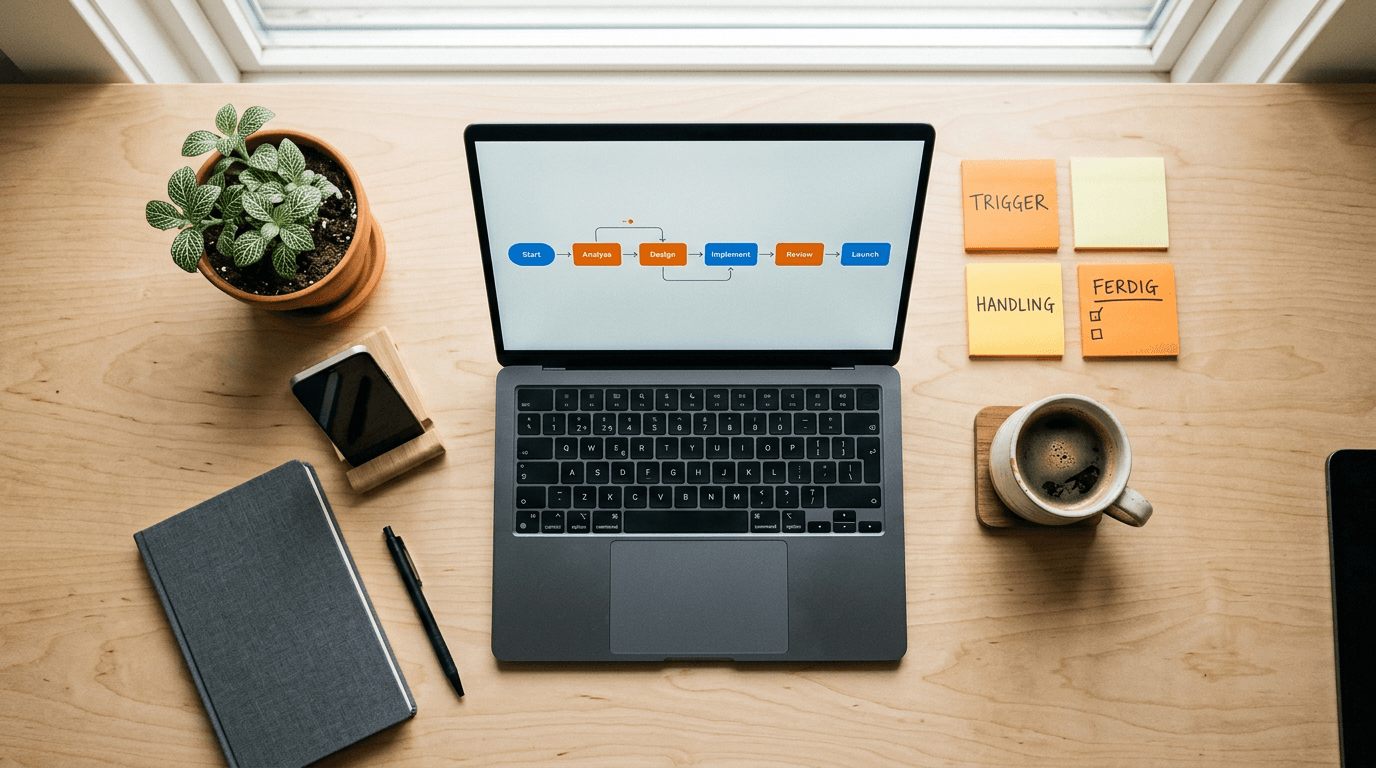

TL;DR: The real questions are where an AI agent should run, what it is allowed to do, and how cost and risk are controlled. For most Norwegian SMBs, hybrid is the most realistic answer: local or Norwegian-controlled deployment for sensitive, repetitive workflows at high volume, cloud or frontier API for demanding reasoning and pilots. Autonomy must be ramped up gradually, and governance (identity, roles, permissions, logging, cost caps) must be in place before the agent is allowed to act freely.
What do we mean by an AI agent in production?
An AI agent is an LLM-based system that plans, uses tools and APIs, remembers context, and carries out a multi-step workflow rather than only answering questions in a chat window. According to Wang et al.'s survey of LLM-based autonomous agents the building blocks are a profile or role, memory, a plan, and an action loop against tools.
In practice, the agent's risk grows with two things: (1) how much tool access it has (CRM, email, accounting, documents), and (2) how much autonomy it has (reads and suggests, executes with approval, or acts without asking). An internal knowledge agent that only looks things up in SharePoint has a very different risk profile from an agent that can send email and create orders on its own.
Local, cloud or hybrid: what is the difference?
Cloud/API: Fastest to start, access to the strongest models, ongoing token and usage cost. Data is stored at a third party, and you depend on the vendor's data processing agreement, region and security practice.
Local/on-prem/private cloud: More control, data residency in Norway or the EU, and potentially lower marginal cost at high and stable volume. But you need in-house expertise, your own hardware, and you take responsibility for patching, backup and model maintenance yourself. According to NVIDIA's announcement of RTX Spark the trend is that local AI agents on powerful workstations are becoming more accessible, up to 1 petaflop of AI compute and 128 GB of unified memory on a Windows machine.
Hybrid: Local model for sensitive document tasks and repetitive workflows, cloud or frontier API for demanding reasoning. A policy-based routing layer decides what runs where. For a Norwegian SMB with mixed data risk, hybrid is often the only sensible answer in practice.
Cost lives beyond the model
Many budgets only cover API cost or model licence and miss the rest. According to Lenovo Press's TCO analysis for generative AI in 2026 the most important metric is cost per million tokens, but that is far from the full picture. The full cost stack for an AI agent in production typically looks like this:
- Token or premium-requests cost paid to the model vendor.
- Licence or SaaS subscription per user or per agent.
- Integration work against existing systems (CRM, ERP, email, calendar).
- Evaluation, logging, monitoring and support.
- Local hardware, hosting, power, backup, patching and model maintenance.
- Human approval, training and process change inside the organisation.
According to LangChain's State of AI Agents 2024 report 51 percent of professionals use AI agents in production, and 78 percent plan production use soon. A usage-based pricing model where you pay per model call or premium request is becoming more relevant for SMBs as well.
When does local deployment pay off?
Local deployment is the best fit when you have:
- High and stable volume, where a smaller open-weights model is good enough.
- Sensitive data (personal information, contracts, financial data, health data) that you do not want to send out of Norway.
- Strict data residency requirements, for example in the public sector or regulated industries.
- A need for low latency, offline operation or edge use.
- Repetitive tasks with predictable input, where you do not need a frontier model's reasoning.
For a slightly larger SMB moving from pilot to production, see how multi-agent solutions from AIKI are built - a local model for standard tasks, cloud for demanding calls, and a clear vendor taking responsibility for stability.
A concrete Norwegian example is Telenor's Sovereign AI Factory, built to offer Norwegian-controlled AI capacity for voice-to-voice translation, the public sector and industrial use cases. In the same lane, Ayfie's partnership with Telenor AI Factory combines Norwegian enterprise search with Norwegian-operated AI infrastructure without third-party access.
When is cloud the better choice?
Cloud is the best fit when you:
- Run a pilot and want to test quickly without tying up capital in hardware.
- Have low or unpredictable volume and do not want to pay for capacity you do not use.
- Need the very best model right now and cannot wait for it to run locally.
- Have little internal operations capacity and want the vendor to handle scaling, updates and security. In that case ongoing AI operations through AIKI is an option without in-house headcount.
- Work with data where you have an approved data processing agreement and sufficient control.
For an SMB that wants to try AI agents for the first time, cloud is almost always the right starting point, but that does not mean the whole architecture should stay in the cloud.
Governance: how to stop the agent from becoming an uncontrolled digital employee
According to OWASP's threat catalogue for agentic AI and Microsoft's recommendations for Power Platform governance agents should be treated as digital colleagues with identity, roles, permissions and continuous monitoring. A practical nine-point model:
- Identity and owner: Every agent has a responsible person in the organisation.
- Role and mandate: What the agent is supposed to do, and just as important, what it is not supposed to do.
- Permissions and least privilege: The agent only gets the access it needs for the task.
- Autonomy levels: Read and suggest, execute with approval, or execute automatically for low risk.
- Logging and audit trail: Every decision and action is logged so you can review it later.
- Human in the loop for high risk: No agent sends email to customers, changes contracts or moves money without approval.
- Cost caps and budget: A monthly ceiling per agent, with an alert when you approach it.
- Evaluation before and after production: Tests that measure whether the agent solves the task correctly, and not just whether it completes it.
- Incident response and shut-off: A plan to stop the agent quickly if something goes wrong.
According to Yehudai et al.'s evaluation survey for LLM agents evaluating agents is a discipline of its own that requires assessment of planning, tool use, reflection, memory, cost, security and robustness. It is not enough to check the final answer, you have to test the whole workflow.
GDPR and the EU AI Act for Norwegian businesses
Local deployment does not remove GDPR responsibility, it reduces some types of data transfer and residency risk, but lawful basis, data minimisation, security, logging and documentation remain regardless. For Norwegian SMBs using AI agents, this means a short checklist in practice:
- Do you have a documented lawful basis for what the agent does?
- Is data minimisation in place, so the agent only sees the data it needs?
- Do you need a DPIA (data protection impact assessment) for this workflow?
- Is the data processing agreement with the model vendor in place, with clear regions and retention periods?
- Do you have access control that prevents the agent from seeing more than it should?
For an independent review of data processing agreement, DPIA and governance model before production, you can book an AI Audit from NOK 130,000.
According to The Future Society's report on AI agents under the EU AI Act the regulation also applies to AI agents, even though it was not written explicitly for agentic AI. Risk classification, documentation, transparency and human oversight apply to all systems that can act autonomously in other systems.
Practical use cases for Norwegian B2B SMBs
A few workflows where hybrid deployment and the governance model above are a particularly good fit:
- Internal knowledge agent or document agent that answers questions from SharePoint, HSE routines and product documentation. Local or hybrid if the documents are sensitive.
- Customer service agent with human handoff that suggests replies, creates tickets and classifies inquiries. Cloud for standard FAQ, hybrid for order and customer data.
- Sales and proposal agent that reads CRM notes and drafts proposals. Human approval before price changes or contract send-out.
- Accounting and finance assistant that explains variances, matches invoices against orders and prepares vouchers. Local or hybrid is often right because of sensitive financial data.
- Project and delivery agent that summarises status, finds blockers and creates tasks in Teams, Slack or Jira. Should suggest, not change plans automatically.
Decision matrix: local, cloud or hybrid
| Criterion | Cloud/API fits best | Local/sovereign fits best | Hybrid fits best |
|---|---|---|---|
| Startup | Fast pilot, low CapEx | Requires more setup | Pilot in cloud, sensitive parts locally |
| Data type | Low sensitivity or anonymised | Personal data, IP, contracts, finance | Mixed data risk |
| Volume | Low or unstable | High and stable | Varying volume with some heavy sensitive workflows |
| Model requirements | Needs a frontier model | Smaller open-weights model is good enough | Local standard, cloud when needed |
| Cost control | Easy to start, can get expensive with agent loops | Higher upfront cost, lower marginal cost at high use | Routine local, demanding calls in cloud |
| Governance | Depends on vendor agreements | More control, more responsibility | Policy-based routing and logging |
| Competence | Lower operations need | Requires IT, ML or DevOps skills | Requires architecture skills but more flexible |
Frequently asked questions
Do AI agents have to run in the cloud?
No. Local deployment, Norwegian sovereign infrastructure and cloud are all valid options, depending on data type, volume and model requirements. Many Norwegian SMBs end up with hybrid, where cloud is used for pilots and demanding reasoning, while local deployment is used for sensitive document tasks.
What is the largest cost driver for an AI agent in production?
Not the model cost, but integration work, monitoring, logging and training. For an agent that needs to talk to CRM, email and accounting, the integration alone can make up half of the total cost in the first year.
What does governance mean in practice for a small business?
That every agent has an owner, a clear mandate, an autonomy level, logging of all actions, a cost cap and a plan to switch it off. For an SMB, a simple spreadsheet or note file per agent is usually enough, as long as it is updated regularly.
Is local deployment GDPR-safe in itself?
No. Local deployment reduces data transfer and residency risk, but lawful basis, data minimisation, access control, logging and documentation must be in place no matter where the agent runs.
Summary
Three takeaways: (1) Local versus cloud is a governance choice that affects data flow, logging, access, cost model and vendor risk. (2) Hybrid is often the most realistic answer for Norwegian SMBs, local or Norwegian-controlled deployment for sensitive tasks, cloud for frontier reasoning and pilots. (3) Governance must be in place before the agent gets autonomy. Want help mapping cost, data flow, security and a first agent pilot? Book an AI Audit call from NOK 130,000 or get in touch with an AIKI advisor.