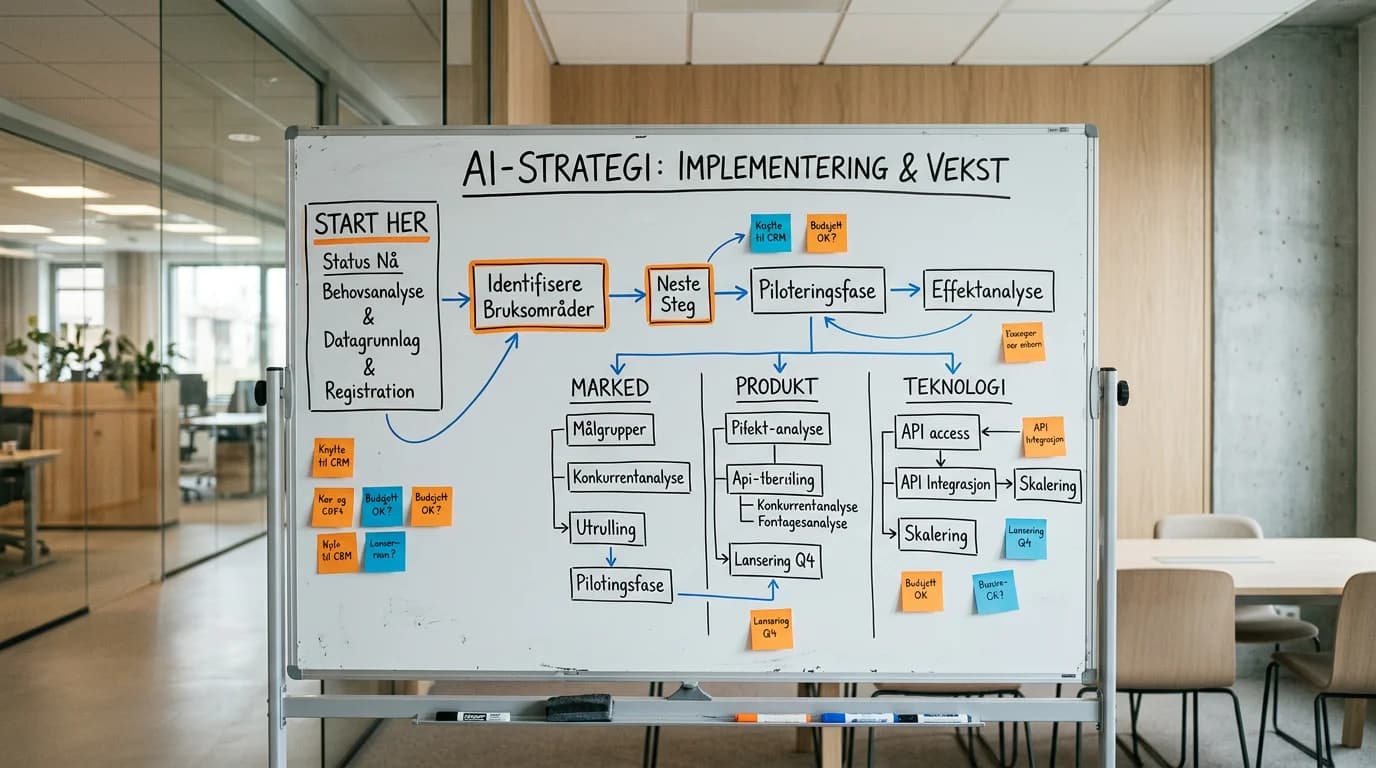
AI automation means software uses artificial intelligence to perform tasks that previously required manual work. According to a McKinsey survey from 2025, 67% of Norwegian mid-sized businesses reported that they had implemented at least one form of AI automation in their core operations. The average time saving among these businesses was 11 hours per employee per week.
For Norwegian SMBs (7-100 employees), AI automation is rarely about replacing staff. It's about removing repetitive tasks so people can spend their time on work that actually requires human judgment.
What separates AI automation from RPA and scripts?
Many people confuse AI automation with RPA (Robotic Process Automation) or simple scripts. RPA performs rule-based tasks precisely: click this button, copy this text, send this email. But RPA can't handle unstructured data or learn from experience.
AI automation, on the other hand, can:
- Understand natural language in emails and documents
- Extract relevant information from unstructured sources
- Predict outcomes based on historical patterns
- Adjust to new situations without manual reprogramming
A script does one thing. AI automation can handle variation and context.
9 concrete examples from Norwegian businesses
1. Accounting firms: Automated invoice and receipt handling
A mid-sized accounting firm in Oslo implemented AI-driven invoice and receipt handling in 2024. The system reads invoices, extracts amounts, counterparties and account numbers, and suggests the right categorization based on historical data. Result: 40% less time spent on manual entry. One accountant can now handle twice as many clients. Time saved per invoice: from 5 minutes to 30 seconds.
2. Legal sector: Contract review
A Norwegian law firm uses AI to review standard contracts for small and medium-sized businesses. The AI identifies risk clauses, missing paragraphs and deviations from industry standards. The lawyer then spends time advising clients instead of reading documents line by line. Estimated time saving: 3-4 hours per contract, from 4 hours to 30 minutes.
3. Healthcare: Patient intake and triage
A private healthcare clinic in Bergen implemented AI-driven patient intake through a chatbot. The patient describes their symptoms, and the AI structures the information before the doctor sees the patient. This reduced the intake process from 15 minutes to 3 minutes per patient. According to the clinic, the system also captures precise information that patients previously forgot to mention.
4. Manufacturing: Predictive maintenance
A Norwegian manufacturing company with 80 employees uses AI to monitor production equipment. Sensors continuously send data to an AI system that predicts when machines need maintenance. The result was a 23% reduction in unplanned downtime during the first year. Estimated saving: NOK 1.2 million in avoided production losses.
5. Retail: Dynamic inventory management
A Norwegian retail chain with 12 stores implemented AI-driven inventory management that calculates optimal stock levels based on sales trends, weather data and seasonality. The system automatically orders goods when inventory approaches a threshold. Result: 18% reduction in waste and 12% reduction in overstocking.
6. HR: Automated application screening
A technology company in Trondheim uses AI to screen job applications. The AI reads CVs and application text, scores candidates against the most important skill requirements, and sends automatic rejections to candidates who don't qualify. The recruiter's time is spent only on qualified candidates. Time saving: 60% less screening time per job posting.
7. Marketing: Personalized customer communication
A Norwegian online store uses AI to generate personalized product recommendations and follow-up emails based on customer purchase history and browsing behavior. The AI also sends automatic trigger-based emails, such as abandoned cart reminders, birthday emails and messages to inactive customers. Result: 22% increase in conversion rate compared with generic campaigns.
8. Customer service: Chatbot for first-line support
A Norwegian insurance company implemented an AI chatbot that handles the 20 most common customer questions. This includes claims, policy information and reimbursement status. Complex cases are escalated to human case handlers. Result: 55% of inquiries are handled by the chatbot without human intervention. Customer satisfaction (NPS) increased from 34 to 41.
9. Finance: Automated reporting
An investment company in Oslo uses AI to generate quarterly reports for investors. The system pulls data from portfolio systems, calculates returns, compares them with benchmark indices, and produces a first draft of the report. An analyst then quality-checks the draft and adds context. Time saving: 8 hours per quarterly report per analyst.
How much time and money do Norwegian businesses save?
| Industry | Task | Traditional time | With AI automation | Saving |
|---|---|---|---|---|
| Accounting | Invoice handling | 5 min/invoice | 30 sec/invoice | ~90% |
| Legal | Contract review | 4 hours/contract | 30 min/contract | ~88% |
| Healthcare | Patient intake | 15 min/patient | 3 min/patient | ~80% |
| Manufacturing | Maintenance planning | Unplanned downtime | Predicted | ~23% reduction |
| HR | Application screening | 20 min/application | 2 min/application | ~90% |
| Customer service | First-line support | 100% manual | ~55% automated | Not stated |
The figures in the table are representative estimates based on experience from Norwegian implementation partners and industry reports from 2024-2025. Actual savings vary by company, data quality and tool choice. The McKinsey report from 2025 documents that businesses that have implemented AI automation in at least one core operation report an average of 11 hours saved per employee per week. For a company with 20 employees, that is 220 hours per week, or more than one full-time position.
Common mistakes Norwegian businesses make
1. Starting too big
Many businesses try to automate the entire workflow at once. It's better to start with one specific task that takes at least 30 minutes per week. Get it working. Measure the result. Then expand.
2. Choosing tools before mapping the process
AI tools are often read as feature lists rather than problem solvers. Before you buy a tool, you need to know exactly which task should be solved, how it's done today, and what success looks like. Without this mapping, you end up with a tool that doesn't fit the actual workflow.
3. Ignoring data quality
AI is only as good as the data it's fed. Businesses with messy CRM data, inconsistent templates or missing historical logs will get weaker results. Data preparation often takes 40-60% of total implementation time. That's an investment, not an obstacle.
4. Not involving employees
Automation that feels like a decision made over employees' heads will meet resistance. The people who will use the system every day should be part of the planning and receive training. This isn't only about acceptance. Employees often know best where the real bottlenecks are.
5. Expecting immediate ROI
AI automation isn't a switch you flip. The first 3-6 months are about training the system, adjusting prompts and building workflows. Don't expect full savings until after 6-12 months. Productivity may even drop in the first months while the team learns.
6. Forgetting privacy and GDPR
AI tools that process personal data must be GDPR-compliant. Healthcare, finance and HR have especially strict requirements. Use tools with documented privacy by design. Always request a DPIA (Data Protection Impact Assessment) when in doubt.
Tool comparison: What fits Norwegian SMBs?
| Tool | Best for | Price (estimate) | Complexity |
|---|---|---|---|
| Make.com | Visual workflows, integrations | From NOK 400/month | Low |
| Custom internal assistant | Knowledge search and routine support | Varies by scope | Medium |
| Zapier | Simple automations, API integrations | From NOK 150/month | Low |
| Custom AI solution | Complex, industry-specific needs | Varies | High |
Prices are based on publicly available information from vendor websites as of May 2026. Complexity refers to the technical competence required for implementation.
Most Norwegian SMBs start with one tool for one task. Then they expand. This is a low-risk approach that gives the team time to learn.
How to get started: 5 steps
Step 1: Map the work
Identify the three tasks you or your employees spend the most time on that are repetitive and rule-based. Choose one. Not three. Typical starting points for Norwegian SMBs include invoice handling, email sorting, customer replies and booking.
Step 2: Set up a pilot project
Choose one department or one process. Test at small scale before rolling it out more widely. Measure the baseline: how long does the task take today? Without a baseline, you won't know whether the automation actually works.
Step 3: Choose a tool
Choose based on how easy it is to get started, privacy certifications, and documented results from similar industries. Always ask for a demo or a free trial before you commit.
Step 4: Test and learn
Run the pilot for 4-6 weeks. Collect feedback from the people using the system. Adjust. Don't expect the first version to be perfect. The best AI automations are the result of many iterations.
Step 5: Measure and expand
Compare the result with the baseline. If the pilot gave a 30% time saving on one task, that's a good sign. Document what worked, then expand to more tasks or departments.
FAQ
What's the difference between AI automation and AI agents? AI agents are autonomous systems that can take several steps on their own to complete a task. AI automation is often about individual tasks that run after a trigger. Agents are more flexible, but also more complex to set up and monitor. Read more in our guide to what AI agents are.
How long does it take to get started? A simple pilot project can get started in 2-4 weeks if the data is tidy. Larger implementations take 3-6 months from mapping to full rollout. The main point: you don't need to wait until everything is ready. Start with one task.
Can small businesses under 10 employees benefit from AI automation? Yes. Even small businesses spend time on repetitive tasks: email handling, booking and simple customer replies. AI tools such as chatbots and automated email handling are available from NOK 150-400 per month. For a small company with one employee, this can free up 5-10 hours per week.
Is AI automation safe from a privacy perspective? It depends on the tool. Choose tools that are GDPR-compliant, do not use your data to train models, and offer data processing agreements. Ask vendors to document storage location, subprocessors and deletion routines before you connect business data.
What does it cost to implement AI automation? A simple automation with off-the-shelf tools costs from NOK 150-600 per month in tool costs, plus internal setup time, typically 10-40 hours for the first implementation. More complex, custom systems can cost from NOK 50,000 to NOK 500,000 as a one-time cost, depending on scope. See our analysis of what it costs to wait with AI for a more detailed assessment.
What does this mean for Norwegian businesses?
AI automation is no longer something only large companies can afford or have the competence to use. The tools have become simpler, cheaper and more accessible for Norwegian SMBs. The average cost of an SMB-ready tool is NOK 200-600 per month.
Your competitors who have already started are saving time and money every single week. According to the McKinsey report from 2025, 11 hours per employee per week is the average among Norwegian businesses that have implemented AI automation in at least one core operation. That equals one extra working day per week, every week, all year.
AI automation isn't an overnight transformation. It's a step-by-step process where each step builds on the previous one. But businesses that start now will be much further ahead in two years than those that wait.
Want to know how AI automation could work in your industry? Talk to one of our advisors. The first conversation is non-binding.