

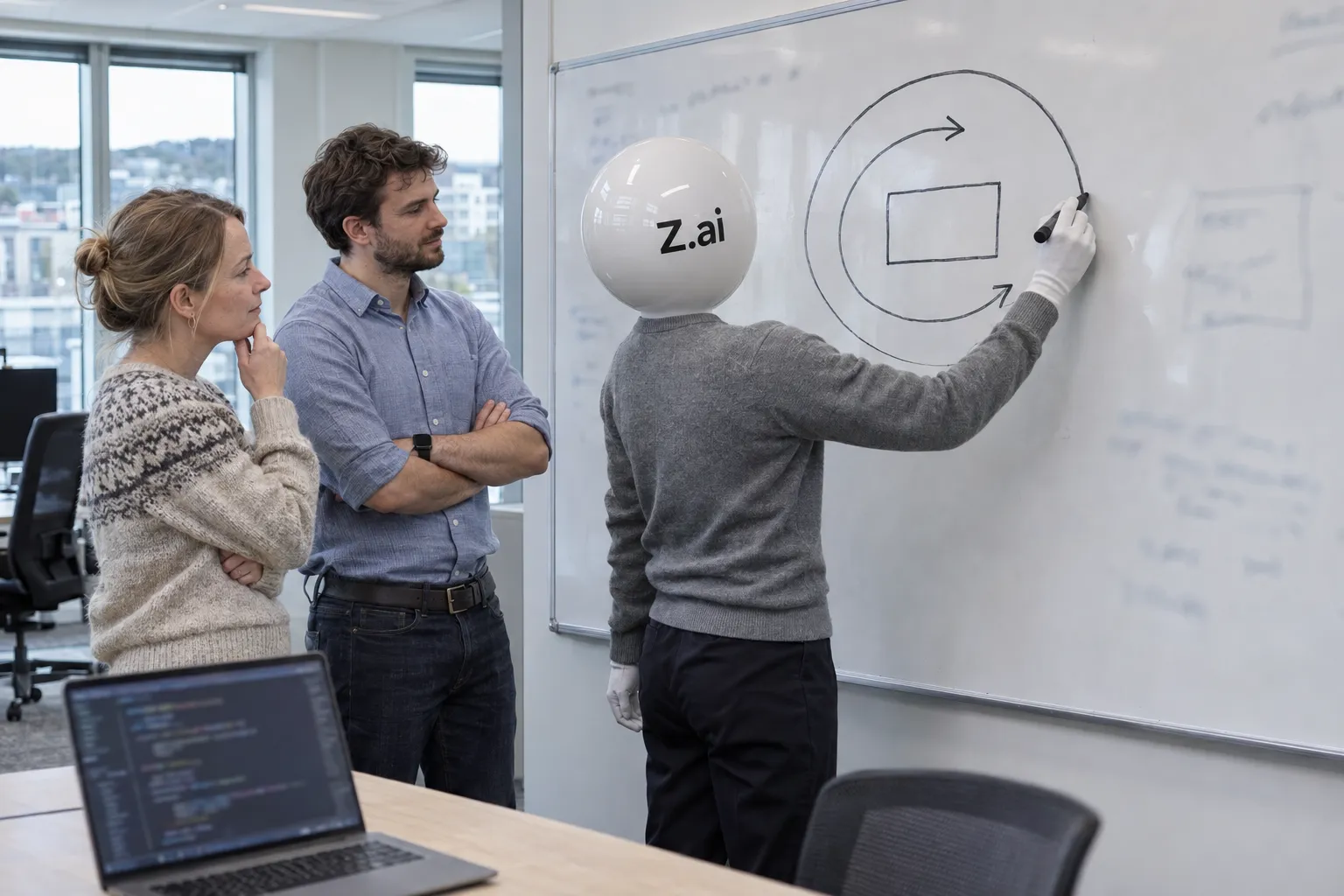
GLM-5.4 is the new flagship model from Z.ai, launched on 23 November 2026, and the first large language model built as a so-called Loop Transformer: part of the model runs twice for every word, so it reasons more deeply with the same number of parameters. For now it is available only in Z.ai's own products, with GLM Coding Plan from USD 18 per month. The API and open weights have been announced, and independent tests do not exist yet.
What is GLM-5.4?
GLM-5.4 is a language model for coding and long tasks from the Chinese company Z.ai (also known as Zhipu AI), the company behind the GLM series. Z.ai calls the direction "Generalized Coding": the model writes code to solve tasks far outside ordinary software, such as making video, building games and drawing mechanical parts.
| Property | GLM-5.4 |
|---|---|
| Launched | 23 November 2026 |
| Developer | Z.ai (GLM series) |
| Architecture | Loop Transformer built on the GLM-5 base model, in the 750B class |
| Context window | 1 million tokens |
| Longest response | 128,000 tokens |
| Reads | Text, images, video and files |
| Writes | Text |
| Speed | Up to 200 tokens per second outside peak hours, 70-80 in peak hours |
| Available in | GLM Coding Plan (Lite, Pro and Max), ZCode and Z.ai Chat |
| API | Coming after Z.ai's safety review |
| Open weights | Announced, but not published as of 24 November 2026 |
Tokens are the word fragments a model reads and writes. What AI models are and how they learn is covered in What is artificial intelligence?.
What is new in GLM-5.4
The predecessor GLM-5.3 was a regular transformer model. This is what is new in GLM-5.4:
- Parts of the model run twice. In a regular language model, each layer runs once per word. In GLM-5.4, 28 of the layers in the GLM-5 base model run in two passes. Z.ai says this gives an intelligence level on par with models of 2 to 3 trillion parameters.
- Rebuilt from a finished model. Z.ai rebuilt a fully trained base model and kept training it, and first tested the setup on models with 1, 4 and 30 billion parameters.
- Shorter thinking. In Z.ai's own experiments on a 30B model, two passes gave shorter answers on most of the tests, 10-14 percent, because part of the reasoning happens inside the model. The experiment used around 10 percent more compute in training.
- Images and video in. GLM-5.4 reads images and video in addition to text. Z.ai shows examples where the model makes a music video with code, designs a robot arm in the FreeCAD software and builds a 3D scene from scratch.
- More quota. On the plans with a weekly quota, users get 1.5 times as much use of GLM-5.4 as of GLM-5.3.
Z.ai itself writes that the model has one clear weakness: it can get stuck in very long rounds of thinking ("marathon thinking") before it answers. According to Z.ai, the long self-checking gives higher accuracy, but it costs time.
Benchmarks and test results
Z.ai has not published test results for GLM-5.4 itself. The launch shows only the experiments on the 30B model, where two passes gave the biggest gain on mathematics, scientific reasoning and long documents. According to TestingCatalog, a Z.ai employee says the figures for the flagship model will come later, and Wccftech points out that the launch skipped the usual tests.
For comparison, Z.ai published a full set of test results for GLM-5.3 at its launch in August 2026, including 84.5 percent on the CyberGym security test, according to our review of GLM-5.3. What the most common tests measure, and how they should be read, is covered in AI benchmarks explained.
Independent measurements of GLM-5.4, for example from LMArena and Artificial Analysis, do not exist yet as of 24 November 2026. Until they arrive, the only basis is Z.ai's own experiments on a smaller model.
GLM-5.4 versus Kimi K3.1 Pro
Both are large Chinese models with 1 million tokens of context and coding as the main use. Today the difference lies mostly in how far each has come out.
| GLM-5.4 | Kimi K3.1 Pro | |
|---|---|---|
| Developer | Z.ai | Moonshot AI |
| Launched | 23 November 2026 | End of October 2026 |
| Architecture | Loop Transformer, 750B class | Mixture-of-Experts, 2.8 trillion parameters |
| Context window | 1 million tokens | 1 million tokens |
| API | Not yet | Yes, USD 2 in and USD 10 out per million tokens |
| Open weights | Not yet | Yes, on Hugging Face |
| Published tests | Only experiments on a 30B model | Full test results and Artificial Analysis |
Kimi K3.1 Pro can thus be tested and measured today. GLM-5.4 is mostly relevant for developers who already use GLM Coding Plan. More about Kimi is in Kimi K3.1 Pro explained.
What does GLM-5.4 cost?
| How | Price (Z.ai, read 24 November 2026) |
|---|---|
| GLM Coding Plan Lite | From USD 18 per month |
| GLM Coding Plan Pro and Max | See Z.ai's subscription page |
| API for GLM-5.4 | Not launched, no price |
| API for GLM-5.3, for comparison | USD 1.4 in and USD 4.4 out per million tokens |
Coding Plan has both a limit per five hours and a weekly limit. Lite gives 2,000 credits per five hours and 10,000 per week, Pro 12,000 and 60,000, and Max 28,000 and 140,000. The subscription works in Claude Code and more than 20 other coding tools, where the model is selected as glm-5.4 (or glm-5.4[1m] for 1 million tokens of context in Claude Code).
What the company should settle first
For developers who want to try a new model on their own code, GLM Coding Plan is an affordable way to test. For the company as a whole, there are three things to settle first.
- Where the data ends up. The Z.ai services are provided by JINGSHENG HENGXING TECHNOLOGY PTE. LTD. in Singapore, and personal data is usually processed there, according to the privacy policy. Transfer from Norway to Singapore requires a valid transfer basis under the GDPR (Norwegian Data Protection Authority on transfers outside the EEA, page in Norwegian). More on this in AI and GDPR in Norway.
- What the data is used for. The privacy policy for individual users lets Z.ai use data to improve and train the models. For API customers, a separate data processing agreement (DPA) applies, under which Z.ai processes data on the customer's behalf. Code with customer data or trade secrets belongs in a solution with a data processing agreement.
- Whether you want to run it yourself. GLM-5.3 has open weights on Hugging Face. Z.ai has announced open weights for GLM-5.4 as well. When they arrive, the model can be run with a cloud provider in the EU, so the data stays there. It requires hardware for a model in the 750B class.
If you are considering an open model in your own systems, for example a coding agent or an internal assistant, AIKI can help with model choice and operations. Read more about AI development.
Sources
- Z.ai: GLM-5.4, documentation and launch text, read 24 November 2026
- Z.ai: GLM Coding Plan, quotas and models, read 24 November 2026
- Z.ai: API pricing, read 24 November 2026
- Z.ai: Privacy policy, read 24 November 2026
- Hugging Face: zai-org, read 24 November 2026
- Norwegian Data Protection Authority (Datatilsynet): Transfer of personal data out of the EEA (page in Norwegian), read 24 November 2026
- Wccftech: Z.ai Debuts GLM-5.4 With a Novel Looped Transformer Architecture, read 24 November 2026
- TestingCatalog: Z.ai launches GLM-5.4, its first Loop Transformer model, read 24 November 2026