


GPT-6.2 Astra is OpenAI's new flagship model, released on 17 November 2026 in ChatGPT and the API together with GPT-6.2 Sol, its model for everyday work. Astra costs 20 percent less per token than GPT-6 Astra. For most businesses Sol covers daily work, while Astra is built for large document, spreadsheet and analysis tasks.
What are GPT-6.2 Astra and GPT-6.2 Sol?
According to OpenAI, GPT-6.2 Astra is its most capable model, built for the hardest projects. GPT-6.2 Sol is OpenAI's new go-to model for everyday work, from coding to AI agents at scale. Astra succeeds GPT-6 Astra, and Sol succeeds GPT-6.1 Sol.
Both models are available in ChatGPT Work and Codex for Plus, Pro, Enterprise and Edu users, and in the API with the model IDs gpt-6.2-astra and gpt-6.2-sol. In Enterprise and Edu, an administrator has to enable them for the workspace.
| Model | Role at OpenAI | Price in / out per million tokens |
|---|---|---|
| GPT-6.2 Astra | Flagship for the hardest projects | USD 8 / 40 |
| GPT-6.2 Sol | Go-to model for everyday work and agents | USD 2 / 10 |
| GPT-6.1 Terra | Fast model for images, computer use and text | USD 1 / 5 |
| GPT-6 Luna | Lowest price, for large volumes of simple tasks | USD 0.10 / 0.50 |
Source: OpenAI model overview and pricing page, read on 18 November 2026. Astra and Sol can read up to 922,000 tokens in one request and write up to 128,000 tokens in one response.
What is new compared with GPT-6 Astra?
Four changes matter most for a business:
- Lower price: Astra costs USD 8 in and USD 40 out per million tokens, down from 10 and 50. Cached input costs USD 0.40, down from USD 1.
- Fewer tokens per task: OpenAI says Astra solves tasks with fewer output tokens. On its internal GDPval v2 test it used 22 percent fewer output tokens than GPT-6 Astra.
- Better documents, spreadsheets and slides: Astra is trained to follow templates and professional conventions in law, sales, finance and accounting, down to the typeface and font size in a slide template.
- Stricter safeguards: both models are rated "Critical" for cybersecurity in OpenAI's Preparedness Framework, so the stricter safeguards also limit some legitimate vulnerability research and security testing.
Sol keeps GPT-6.1 Sol's price (USD 2 in and USD 10 out). According to OpenAI, both models outperform their predecessors on benchmarks, and Astra costs less per token.
Benchmarks: how good is GPT-6.2 Astra?
The figures below are OpenAI's own, from the launch page. Agents' Last Exam measures multi-step professional work. The table shows each model's best reasoning setting and the cost per task at that setting.
| Model (Agents' Last Exam v1.1) | Score | Cost per task |
|---|---|---|
| GPT-6.2 Astra (xhigh) | 78.3% | USD 2.89 |
| Gemini 4 Carbon (high) | 77.4% | USD 4.60 |
| GPT-6 Astra (max) | 73.1% | USD 8.99 |
| GPT-6.2 Sol (max) | 73.0% | USD 1.32 |
| Claude Fable 5.2 (max) | 72.8% | USD 60.05 |
| GPT-6.1 Sol (max) | 72.5% | USD 2.02 |
| Claude Opus 5.5 (max) | 71.6% | USD 17.57 |
Astra scores 5.2 points above GPT-6 Astra (78.3 against 73.1) at less than a third of the cost (USD 2.89 against 8.99), and 5.5 points above Claude Fable 5.2 at less than 5 percent of the cost. Google's Gemini 4 Carbon comes close on this test. Google has since launched Gemini 4 Neon, which sits between Carbon and Hydrogen. The cost per task here is OpenAI's measurement and cannot be compared directly with the Artificial Analysis cost figures further down.
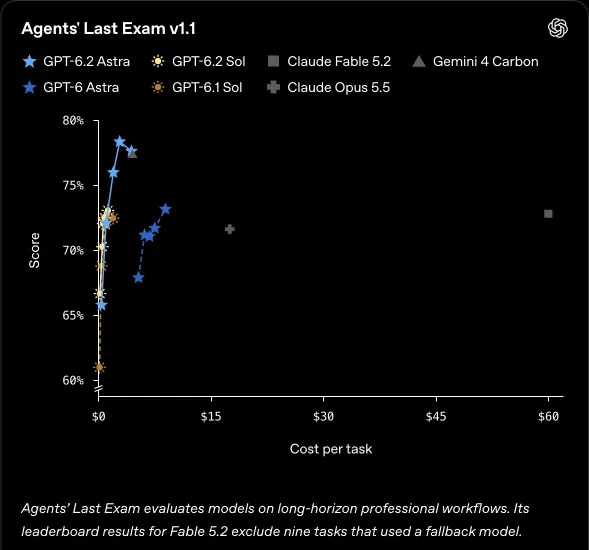
Source: OpenAI, Introducing GPT-6.2 Astra and Sol. Screenshot taken on 18 November 2026.
How to read the other tests OpenAI highlights (more in AI benchmarks explained):
| Test | What it measures | Result according to OpenAI |
|---|---|---|
| GDPval v2 | Tasks in consulting, finance and design (OpenAI's internal test) | Astra 6.2 percentage points above GPT-6 Astra; Sol 5.3 above GPT-6.1 Sol |
| Harvey LAB-AA v1.1 | Legal tasks such as contract clause analysis | Astra more than doubles Claude Fable 5.2's pass rate at about one-sixth of the cost |
| AA-AnalystAgent | Artificial Analysis test that OpenAI cites | Astra answered 62.5 percent of questions correctly on all five attempts |
| FrontierCode 2.0 | Whether code changes meet the quality bar of real projects | Sol 0.5 points behind Astra at about one-fifth of the cost |
| AA-3D | Human judges compare two blinded interactive 3D experiences | Astra 1,318 Elo, Fable 5.2 1,271, Sol 1,259 |
What independent measurements say
In the Artificial Analysis Intelligence Index v5, which combines nine evaluations across knowledge work, coding, science and general knowledge, GPT-6.2 Astra scores 62 points, three behind Claude Fable 5.2 (65). The Decoder reports the same figures.
| Model (highest setting unless stated) | Intelligence Index v5 | Cost per task |
|---|---|---|
| Claude Fable 5.2 | 65 | USD 26.54 |
| GPT-6.2 Astra | 62 | USD 4.00 |
| Gemini 4 Carbon (high) | 60 | USD 5.48 |
| Claude Opus 5.5 | 59 | USD 10.04 |
| GPT-6.2 Sol | 57 | USD 1.01 |
Source: Artificial Analysis, GPT-6.2 Astra, read on 18 November 2026.
Fable 5.2 scores 3 points more than Astra, but a task costs more than six times as much. Three caveats from the independent measurements, as reported by The Decoder:
- Coding has flatlined. On the Artificial Analysis Coding Agent Index, Astra stays where GPT-6 Astra was, and Sol dropped 3 points from GPT-6.1 Sol.
- Guessing on hard factual questions. At maximum effort, Astra guessed in 59 percent of the cases where it should have said it did not know, and Sol in 55 percent. The questions are unusually hard, so the figure says little about everyday use, but it is a reason to check facts in important deliverables.
- Weaker on real research tasks. Epoch AI found Astra on par with Fable 5.2 on its overall index, but behind Fable 5.2 on tasks taken from its own research work.
What have people built with GPT-6.2 Astra?
The examples below were published by OpenAI and its customers on launch day. They were selected by those who published them, and we have found no independent verification.
| Who | What Astra did |
|---|---|
| OpenAI | Built an editable Excel model for a fictional company with a revenue forecast per segment to 2031, reconciliation of the three financial statements and value per share with a sensitivity analysis |
| OpenAI | Made a presentation in OpenAI's own template, with the same layout, colours and typography, and slide titles meant to state the main point of each slide |
| Basis | Average time on long-horizon accounting work fell by 50 percent, and by up to 73 percent for the most complex work |
| IMC | Marquis Wong at IMC says the documents were a significant step up from GPT-6 Astra, and that the writing and charts made it much easier to pick out the key points of a briefing |
| Higgsfield AI | Hit the intended 3D result on the first attempt in 73 percent of cases in Higgsfield's internal test, where GPT-6 Astra needed three attempts or more |
The accounting example from Basis is closest to everyday work in most businesses.
What do early testers say about GPT-6.2 Astra?
Developer Theo Browne (t3.gg), who tested Astra before launch, wrote on X on launch day: "I think this is the worst model OpenAI has ever released." In a longer letter to OpenAI, published the same day, he writes: "I would not choose this over Opus 5.5 for my work as a developer."
His criticism covers three things:
- Long runs go in circles. On his own test project, a rewrite of the TypeScript compiler in Rust, Astra ran for seven days without landing a single improvement, and the compiler ended up 56 percent slower. Four more days produced no changes.
- It blocks itself with questions. In the middle of long tasks, the model asks the user about internal implementation details the user could not have any input on.
- Its explanations are hard to read. The summaries go so deep into detail that the main point gets lost, and system prompt adjustments did not fix it.
He also lists strengths: Astra is a strong reviewer, occasionally finds genuinely good new solutions, writes better code than before and is strong at computer use. He writes that he is likely overreacting. This is one experienced user's experience on his own projects, and it fits the measurement above showing that Astra has not improved on coding agent tasks.
For a business, the lesson is the same as with any model change: test on your own tasks before you switch, especially where the model will work on its own for a long time.
GPT-6.2 Astra or Claude Fable 5.2: what is the difference?
The token price is the same, USD 8 in and USD 40 out per million tokens according to Anthropic's pricing page. Even so, the cost per task at Artificial Analysis is USD 4.00 for Astra against USD 26.54 for Fable 5.2.
| GPT-6.2 Astra | Claude Fable 5.2 | |
|---|---|---|
| Price in / out per million tokens | USD 8 / 40 | USD 8 / 40 |
| Intelligence Index v5 (Artificial Analysis) | 62 points | 65 points |
| Cost per task, highest setting (Artificial Analysis) | USD 4.00 | USD 26.54 |
| Agents' Last Exam v1.1 (OpenAI's figures) | 78.3% | 72.8% |
| FrontierCode 2.0, coding (OpenAI's chart) | Lower peak score | Highest peak score |
Fable 5.2 has the highest overall score at Artificial Analysis and the highest peak score on FrontierCode 2.0 in OpenAI's own comparison. Astra comes close at a fraction of the cost per task. How the two work in day-to-day use is covered in ChatGPT vs Claude.
How much do GPT-6.2 Astra and Sol cost?
In ChatGPT, GPT-6.2 Astra and Sol are available to Plus, Pro, Enterprise and Edu users. OpenAI's announcement lists these four plans.
In the API you pay per token. The table shows a hypothetical job of 1,000 responses where each response uses 1,000 input tokens and 500 output tokens, without caching:
| Model | Input (USD per 1M tokens) | Output (USD per 1M tokens) | 1,000 responses (USD) |
|---|---|---|---|
| GPT-6 Astra | 10 | 50 | 35 |
| GPT-6.2 Astra | 8 | 40 | 28 |
| GPT-6.2 Sol | 2 | 10 | 7 |
Calculation: 1,000 responses × 1,000 tokens = 1 million input tokens, and 1,000 responses × 500 tokens = 0.5 million output tokens. For GPT-6.2 Astra that is 8 + 0.5 × 40 = USD 28. Source: OpenAI pricing page, read on 18 November 2026.
Four things affect the bill:
- Reasoning effort. The models have five levels, from low to max. In OpenAI's figures, Astra at xhigh scored higher than at max on Agents' Last Exam (78.3 against 77.6 percent), at USD 2.89 against 4.47 per task.
- Long requests. Above 272,000 input tokens, the input price doubles and output costs 1.5 times as much for the whole request.
- Waiting time. Batch costs half the Standard rate. If the answer can wait, background requests in the Responses API (beta) cost 30 percent less with a two-hour window and 40 percent less with an eight-hour window.
- Speed. Fast mode costs twice as much. Ultrafast costs three times the Standard rate through 28 February 2027 and six times from 1 March 2027.
Should your business use GPT-6.2 Astra?
For most businesses the answer is: Sol for most work, Astra for the heaviest document and analysis tasks.
| Task | Model to test first |
|---|---|
| Sorting, extraction and short answers at high volume | GPT-6 Luna |
| Email, customer service drafts, simple coding and agents | GPT-6.2 Sol |
| Spreadsheet models, slides from a template, legal and financial work | GPT-6.2 Astra |
| Large, open-ended programming tasks | Test Astra against Claude Fable 5.2 on your own examples |
Check two things before you use Astra or Sol through the API:
- Where the data is processed. According to OpenAI's data residency documentation, GPT-6.2 Astra and Sol support storage and processing in Europe (EEA and Switzerland) with Standard, Fast and Batch, but Ultrafast only in the US. The region is selected when you create a project, and the pricing page lists a 10 percent uplift for regional processing. If you process personal data, settle this against your data processing agreement, see AI and GDPR in Norway.
- Changes to the integration. GPT-6.2 changes how the Responses API keeps reasoning when a conversation is edited, and how the instructions field is handled. If you are moving an existing solution from GPT-6 Astra, read OpenAI's migration guide and test before you switch.
If you want to find out which tasks in your business need a flagship model, an AI consultant can go through the workflow with you. We also build the solutions, see AI development, and train staff to use ChatGPT and choose the right model in our ChatGPT course. For another recent model, see Qwen4-Max.
Sources
- OpenAI: Introducing GPT-6.2 Astra and Sol, 17 November 2026 (availability, prices, Agents' Last Exam, GDPval v2, Harvey LAB-AA, AA-3D, customer examples and safety)
- OpenAI: model page for GPT-6.2 Astra, model page for GPT-6.2 Sol, pricing page and changelog (context window, prices, reasoning levels, launch date)
- OpenAI: Data residency (EU processing for GPT-6.2)
- Anthropic: pricing page (price of Claude Fable 5.2)
- Artificial Analysis: GPT-6.2 Astra (Intelligence Index v5 and cost per task)
- The Decoder: OpenAI launches GPT-6.2 Astra and Sol with lower API prices and some benchmark gains (Artificial Analysis on coding and guessing, Epoch AI)
- Theo Browne on X: the post on Astra and the letter "Why I hate GPT-6.2 Astra", 17 November 2026 (experience from testing before launch)